P0430-CATALYST EFFICIENCY (BANK 2)
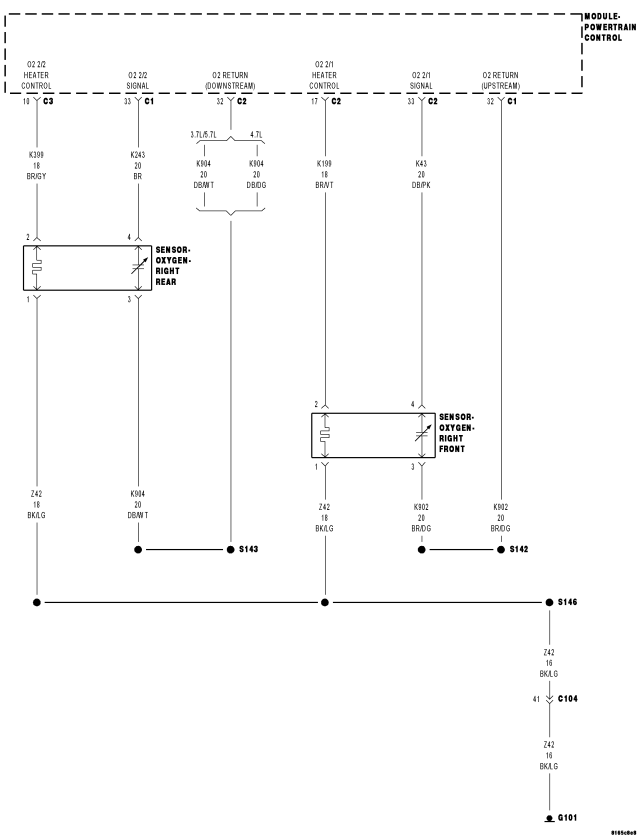
For a complete wiring diagram Refer to Section 8W.
Theory of Operation
The State of Change (SOC) catalyst monitor uses the signals from both the upstream and downstream O2 sensors to detect aging of the catalyst. Based on the fact that when a catalyst ages, it loses some of its Oxygen Storage Capacity (OSC). As a result, part of the untreated exhaust gases can breakthrough the catalyst and causes the downstream O2 sensor to deviate from its neutral (Stoichiometric) position. By observing the activities in the downstream O2 signal, the degradation level of catalyst can be detected. In general, the higher the downstream O2 sensor SOC value, the more exhaust gas breakthrough and the lower the OSC of the catalytic converter.
- When Monitored:
The monitor will run at between 1400 and 2300 RPM. It also runs between 40 and 70 KPA.
- Set Condition:
If the final State of Change index is within the calibrated fail threshold. Two trip fault. Three good trips to turn off the MIL.
| Possible Causes |
| EXHAUST LEAK |
| ENGINE MECHANICAL |
| AGING O2 SENSOR |
| CATALYTIC CONVERTER |
Always perform the Pre-Diagnostic Troubleshooting procedure before proceeding. (Refer to 9 - ENGINE - DIAGNOSIS AND TESTING).
Diagnostic Test
1.ACTIVE DTCNOTE: A new rear O2 Sensor along with an aging front O2 Sensor may cause the DTC to set. Review the repair history of the vehicle before continuing.
NOTE: If an O2 Sensor DTC set along with the Catalytic Converter Efficiency DTC diagnose the O2 Sensor DTC(s) before continuing.
NOTE: Check for contaminants that may have damaged the O2 Sensor and Catalytic Converter: contaminated fuel, unapproved silicone, oil and coolant, repair necessary.
NOTE: It may be necessary to drive the vehicle to meet the conditions to set this DTC, try to repeat the conditions in which the fault originally set by reviewing the Freeze Frame data.
Is the DTC Active or Pending at this time?
Yes
- Go To 2
No
- Refer to the INTERMITTENT CONDITION Diagnostic Procedure.
- Perform the POWERTRAIN VERIFICATION TEST. (Refer to 9 - ENGINE - STANDARD PROCEDURE)
2.VISUALLY INSPECT CATALYTIC CONVERTER
Were any problems found?
Yes
- Replace the Catalytic Converter. Repair the condition that may have caused the failure.
- Perform the POWERTRAIN VERIFICATION TEST. (Refer to 9 - ENGINE - STANDARD PROCEDURE)
No
- Go To 3
3.CHECKING THE EXHAUST SYSTEM FOR LEAKS
WARNING: The normal operating temperature of the exhaust system is very high. Never work around or attempt to service any part of the exhaust system until it has cooled. Special care should be taken when working near the catalytic converter. The temperature of the converter rises to a high level after a short period of engine operating time
CAUTION: The air pressure must not exceed 27.6 kPa (4 psi), otherwise engine damage can occur.
Type 1 Leak
Type 2 Leak
| Leak Location | Repair required if results at 27.6 kPa (4 psi) reveal bubble size: |
| Welded joints | Type 1, 1 mm (0.04 of an inch) or greater |
| O2 Sensor seal points | Type 1, 1 mm (0.04 of an inch) or greater |
| O2 Sensor boss welds | Type 1, 1 mm (0.04 of an inch) or greater |
| Flange / joint connections | Type 2, 8 mm (0.3 of an inch) or greater |
| Exhaust Manifold to cylinder head connections | Type 2, 8 mm (0.3 of an inch) or greater |
| EGR gasket and tube seal points | Type 2, 8 mm (0.3 of an inch) or greater |
Were any exhaust leaks found?
Yes
- Repair or replace the leaking exhaust parts as necessary.
- Perform the POWERTRAIN VERIFICATION TEST. (Refer to 9 - ENGINE - STANDARD PROCEDURE)
No
- Go To 4
4.ENGINE MECHANICAL
Is an engine mechanical condition present?
Yes
- Repair the engine mechanical condition as necessary.
- Perform the POWERTRAIN VERIFICATION TEST. (Refer to 9 - ENGINE - STANDARD PROCEDURE)
No
- Go To 5
5.AGING O2 SENSOR
Has the rear O2 Sensor been replaced without replacing the front O2 Sensor?
Yes
- Replace the 2/1 O2 Sensor as necessary.
- Perform the POWERTRAIN VERIFICATION TEST. (Refer to 9 - ENGINE - STANDARD PROCEDURE)
No
- Go To 6
6.CATALYTIC CONVERTER
If there are no possible cause remaining, view repair.
Repair
- Replace the Catalytic Converter.
- Perform the POWERTRAIN VERIFICATION TEST. (Refer to 9 - ENGINE - STANDARD PROCEDURE)