P050D-COLD START ROUGH IDLE
For a complete wiring diagram Refer to Section 8W
Theory of Operation
The objective of the Dynamic Crankshaft Fuel Control is to reduce the fuel as much as possible during a cold start. The DCFC begins subtracting fuel from a high limit upon a cold start and keeps removing fuel in an attempt to get to a calibrated lean limit. DCFC stops removing fuel when rough idle is detected or the lean limit is reached.
- When Monitored:
Cold start condition. Ambient Air temperature between -7°C and 50 °C (19.4°F and 122°F). Engine Coolant temperature between -7°C and 50 °C (19.4°F and 122°F). The difference between the Ambient Air temp and ECT temp at Start is equal to or less than 10°C (50°F). Engine running at idle only.
- Set Condition:
If a rough idle is detected and the Dynamic Crankshaft Fuel Control remains or returns to the high limit window for a calibrated time. Two trip fault.
| Possible Causes |
| ENGINE MECHANICAL PROBLEM |
| 1/1 O2 SENSOR |
| MAP SENSOR |
| ECT SENSOR |
| IGNITION COIL |
| SPARK PLUG |
| FUEL INJECTOR |
| INTERNAL FUEL LEAK |
| FUEL PUMP MODULE |
| RESTRICTED FUEL SUPPLY LINE |
| FUEL PUMP INLET STRAINER PLUGGED |
| PCM |
Diagnostic Test
1.CHECKING FOR CYLINDER MISFIRE CONDITION PRESENTNOTE: Check for any TSBs that apply to a Misfire condition. Review the vehicle repair history for any misfire condition repairs that have been performed.
NOTE: Reviewing the vehicle repair history may aid in the repair of the misfire condition.
Is there a misfire present at this time?
Yes
- Refer to the appropriate Cylinder Misfire Diagnostic procedure.
- Perform the POWERTRAIN VERIFICATION TEST. (Refer to 9 - ENGINE - STANDARD PROCEDURE)
No
- Go To 2
2.ACTIVE DTC
NOTE: Check for contaminants that may have damaged an O2 Sensor: contaminated fuel, unapproved silicone, oil and coolant.
NOTE: It may be necessary to drive the vehicle to meet the conditions to set this DTC, try to repeat the conditions in which the fault originally set by reviewing the Freeze Frame data.
Is the DTC Active or Pending at this time?
Yes
- Go To 3
No
- Refer to the INTERMITTENT CONDITION Diagnostic Procedure.
- Perform the POWERTRAIN VERIFICATION TEST. (Refer to 9 - ENGINE - STANDARD PROCEDURE)
3.CHECKING FUEL PRESSURE
WARNING: The fuel system is under a constant pressure (even with the engine off). Before testing or servicing any fuel system hose, fitting or line, the fuel system pressure must be released. Failure to follow these instructions can result in personal injury or death.
NOTE: The DTC needs to be cleared before actuating the System Test, if the DTC is not cleared, the System Test may not be allowed to actuate.
NOTE: Fuel pressure specification is 407 kPa +/- 34 kPa (59 psi +/- 5 psi).
Choose a conclusion that best matches your fuel pressure reading.
Within Specification
- Go To 4
Above Specification
- Replace the fuel filter/pressure regulator.
- Perform the POWERTRAIN VERIFICATION TEST. (Refer to 9 - ENGINE - STANDARD PROCEDURE)
Below Specification
- Go To 13
CAUTION: Stop All Actuations.
4.O2 SENSOR OPERATION
NOTE: If one of the O2 Sensor's Signal or Return circuit is shorted to ground the scan tool will display all O2 Sensor voltage readings low. The O2 Sensor that is shorted to ground will display a voltage reading near or at 0 volts.
NOTE: If one of the O2 Sensor Signal or Return circuits are shorted to voltage, the scan tool will display all O2 Sensor voltage readings high.
NOTE: After the repairs have been made, verify proper O2 Sensor operation. If all the O2 Sensor voltage readings have not returned to normal, follow the diagnostic procedure for the remaining O2 Sensors.
Is the voltage switching between 2.5 and 3.4 volts for all the O2 Sensors?
Yes
- Go To 5
No
- Go To 9
5.1/1 O2 SENSOR HEATER OPERATION
NOTE: Wait a minimum of 10 minutes to allow the O2 Sensor to cool down before continuing the test. Allow the O2 Sensor voltage to stabilize at 5.0 volts.
NOTE: The DTC needs to be cleared before actuating the Heater Test, if the DTC is not cleared, the Heater Test may not be allowed to actuate.
Does the voltage stay above 4.5 volts?
Yes
- Replace the 1/1 O2 Sensor.
- Perform the POWERTRAIN VERIFICATION TEST. (Refer to 9 - ENGINE - STANDARD PROCEDURE)
No
- Go To 6
6.MAP SENSOR OPERATION
NOTE: If engine will not idle, maintain a constant RPM above idle.
Is the scan tool reading within 1" of the Vacuum Gauge reading?
Yes
- Go To 7
No
- Replace the MAP Sensor.
- Perform the POWERTRAIN VERIFICATION TEST. (Refer to 9 - ENGINE - STANDARD PROCEDURE)
7.ECT SENSOR OPERATION
NOTE: For this test to be valid, the thermostat must be operating correctly.
NOTE: This test works best if performed on a cold engine (cold soak)
NOTE: If engine coolant temperature is above 82°C (180°F), allow the engine to cool until 65°C (150°F) is reached.
Did the ECT value increase smoothly and did it reach at least 82°C (180°F)?
Yes
- Go To 8
No
- Replace the Engine Coolant Temperature Sensor.
- Perform the POWERTRAIN VERIFICATION TEST. (Refer to 9 - ENGINE - STANDARD PROCEDURE)
8.ENGINE MECHANICAL PROBLEM
Are there any engine mechanical problems?
Yes
- Repair as necessary.
- Perform the POWERTRAIN VERIFICATION TEST. (Refer to 9 - ENGINE - STANDARD PROCEDURE)
No
- Go To 12
9.1/1 O2 SENSOR
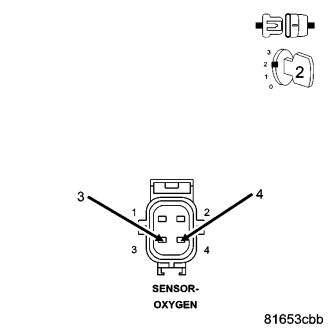
NOTE: The voltage should drop from 5.0 volts to 2.5 volts with the jumper wire in place.
Did the O2 Sensor voltage change from 5.0 volts to 2.5 volts with the jumper wire installed?
Yes
- Replace the O2 Sensor.
- Perform the POWERTRAIN VERIFICATION TEST. (Refer to 9 - ENGINE - STANDARD PROCEDURE)
No
- Go To 10
NOTE: Remove the jumper wire before continuing.
10.(K41) O2 SENSOR 1/1 SIGNAL CIRCUIT
NOTE: The scan tool will display all O2 Sensor voltage readings approximately 5.0 volts when only one O2 Sensor's Signal circuit is shorted to voltage.
NOTE: The scan tool will display one O2 Sensor voltage close to zero and the others will read lower than normal when one O2 Sensor Signal circuit contains excessive resistance.
Is the voltage above 4.8 volts?
Yes
- Go To 11
No
- Check the (K41) O2 Sensor 1/1 Signal circuit for a short to ground, open, or short to voltage. Inspect the O2 Sensor connector and the PCM harness connector. If OK, replace and program the Powertrain Control Module per Service Information.
- Perform the POWERTRAIN VERIFICATION TEST. (Refer to 9 - ENGINE - STANDARD PROCEDURE)
11. (K902) O2 UPSTREAM RETURN CIRCUIT
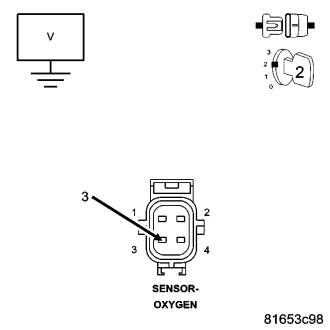
Is the voltage at 2.5 volts?
Yes
- Go To 12
No
- Check the O2 Return circuit for a short to ground, open, or short to voltage. Inspect the O2 Sensor connector and the PCM harness connector. If OK, replace and program the Powertrain Control Module per Service Information.
- Perform the POWERTRAIN VERIFICATION TEST. (Refer to 9 - ENGINE - STANDARD PROCEDURE)
12.PCM
NOTE: Before continuing, check the PCM harness connector terminals for corrosion, damage, or terminal push out. Repair as necessary.
Were there any problems found?
Yes
- Repair as necessary.
- Perform the POWERTRAIN VERIFICATION TEST. (Refer to 9 - ENGINE - STANDARD PROCEDURE)
No
- Replace and program the Powertrain Control Module per Service Information.
- Perform the POWERTRAIN VERIFICATION TEST. (Refer to 9 - ENGINE - STANDARD PROCEDURE)
13.RESTRICTED FUEL SUPPLY LINE
WARNING: The fuel system is under a constant pressure (even with the engine off). Before testing or servicing any fuel system hose, fitting or line, the fuel system pressure must be released. Failure to follow these instructions can result in personal injury or death.
NOTE: The DTC needs to be cleared before actuating the System Test, if the DTC is not cleared, the System Test may not be allowed to actuate.
NOTE: Fuel pressure specification is 407 kPa +/- 34 kPa (59 psi +/- 5 psi).
Is the fuel pressure within specification?
Yes
- Repair or replace fuel supply line as necessary.
- Perform the POWERTRAIN VERIFICATION TEST. (Refer to 9 - ENGINE - STANDARD PROCEDURE)
No
- Go To 14
CAUTION: Stop All Actuations.
14.FUEL PUMP INLET STRAINER
WARNING: The fuel system is under a constant pressure (even with the engine off). Before testing or servicing any fuel system hose, fitting or line, the fuel system pressure must be released.
Is the Fuel Inlet Strainer plugged?
Yes
- Replace the Fuel Pump Inlet Strainer.
- Perform the POWERTRAIN VERIFICATION TEST. (Refer to 9 - ENGINE - STANDARD PROCEDURE)
No
- Go To 15
15.FUEL PUMP MODULE
If there are no possible causes remaining, view repair.
Repair
- Replace the Fuel Pump Module.
- Perform the POWERTRAIN VERIFICATION TEST. (Refer to 9 - ENGINE - STANDARD PROCEDURE)