P2138-ACCELERATOR PEDAL POSITION SENSOR 1/2 CORRELATION
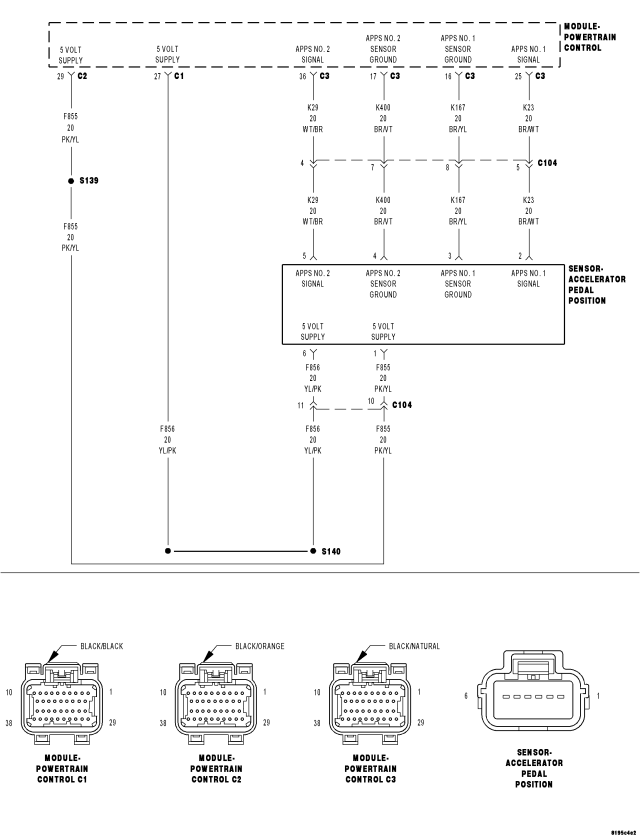
For a complete wiring diagram Refer to Section 8W.
- When Monitored:
With the ignition on and no APPS No.1 and APPS No.2 DTC present.
- Set Condition:
APPS values No.1 and No.2 are not coherent. Idle is additionally forced when the brake pedal is pressed or failed. Acceleration rate and Engine output are limited. One trip fault and the code will set within 5 seconds. ETC light is flashing.
| Possible Causes |
| EXCESSIVE RESISTANCE IN THE (F855) 5-VOLT SUPPLY CIRCUIT |
| EXCESSIVE RESISTANCE IN THE (F856) 5-VOLT SUPPLY CIRCUIT |
| EXCESSIVE RESISTANCE IN THE (K167) SENSOR NO.1 RETURN CIRCUIT |
| EXCESSIVE RESISTANCE IN THE (K400) SENSOR NO.2 RETURN CIRCUIT |
| EXCESSIVE RESISTANCE IN THE (K23) APP SENSOR NO.1 SIGNAL CIRCUIT |
| EXCESSIVE RESISTANCE IN THE (K29) APP SENSOR NO.2 SIGNAL CIRCUIT |
| APP SENSOR |
| PCM |
Always perform the Pre-Diagnostic Troubleshooting procedure before proceeding. (Refer to 9 - ENGINE - DIAGNOSIS AND TESTING).
Diagnostic Test
1.ACTIVE DTCNOTE: When this DTC is Active the engine speed, torque, and vehicle speed are limited to a Limp in mode.
NOTE: Repair any other 5-Volt Supply or APPS High and Low DTCs before diagnosing P2138.
Is the DTC Active at this time?
Yes
- Go To 2
No
- Refer to the INTERMITTENT CONDITION Diagnostic Procedure.
- Perform the POWERTRAIN VERIFICATION TEST. (Refer to 9 - ENGINE - STANDARD PROCEDURE)
2.EXCESSIVE RESISTANCE IN THE (K23) APPS NO.1 SIGNAL CIRCUIT
CAUTION: Do not probe the PCM harness connectors. Probing the PCM harness connectors will damage the PCM terminals resulting in poor terminal to pin connection. Install Miller Special Tool #8815 along with the #8815-1 to perform the diagnosis.
WARNING: When the engine is operating, do not stand in direct line with the fan. Do not put your hands near the pulleys, belts, or fan. Do not wear loose clothing. Failure to follow these instructions can result in personal injury or death.
Is the voltage below 0.5 of a volt?
Yes
- Go To 3
No
- Repair the excessive resistance in the (K23) APP Sensor No.1 Signal circuit.
- Perform the POWERTRAIN VERIFICATION TEST. (Refer to 9 - ENGINE - STANDARD PROCEDURE)
3.EXCESSIVE RESISTANCE IN THE (K167) SENSOR NO.1 RETURN CIRCUIT
WARNING: When the engine is operating, do not stand in direct line with the fan. Do not put your hands near the pulleys, belts, or fan. Do not wear loose clothing. Failure to follow these instructions can result in personal injury or death.
Is the voltage below 0.5 of a volt?
Yes
- Go To 4
No
- Repair the excessive resistance in the (K167) Sensor No.1 Return circuit.
- Perform the POWERTRAIN VERIFICATION TEST. (Refer to 9 - ENGINE - STANDARD PROCEDURE)
4.EXCESSIVE RESISTANCE IN THE (K29) APPS NO.2 SIGNAL CIRCUIT
WARNING: When the engine is operating, do not stand in direct line with the fan. Do not put your hands near the pulleys, belts, or fan. Do not wear loose clothing. Failure to follow these instructions can result in personal injury or death.
Is the voltage below 0.5 of a volt?
Yes
- Go To 5
No
- Repair the excessive resistance in the (K29) APP Sensor No.2 Signal circuit.
- Perform the POWERTRAIN VERIFICATION TEST. (Refer to 9 - ENGINE - STANDARD PROCEDURE)
5.EXCESSIVE RESISTANCE IN THE (K400) SENSOR NO.2 RETURN CIRCUIT
WARNING: When the engine is operating, do not stand in direct line with the fan. Do not put your hands near the pulleys, belts, or fan. Do not wear loose clothing. Failure to follow these instructions can result in personal injury or death.
Is the voltage below 0.5 of a volt?
Yes
- Go To 6
No
- Repair the excessive resistance in the (K400) Sensor No.2 Return circuit.
- Perform the POWERTRAIN VERIFICATION TEST. (Refer to 9 - ENGINE - STANDARD PROCEDURE)
6.EXCESSIVE RESISTANCE IN THE (F855) 5-VOLT SUPPLY CIRCUIT
WARNING: When the engine is operating, do not stand in direct line with the fan. Do not put your hands near the pulleys, belts, or fan. Do not wear loose clothing. Failure to follow these instructions can result in personal injury or death.
Is the voltage below 0.5 of a volt?
Yes
- Go To 7
No
- Repair the excessive resistance in the (F855) 5-volt Supply circuit.
- Perform the POWERTRAIN VERIFICATION TEST. (Refer to 9 - ENGINE - STANDARD PROCEDURE)
7.EXCESSIVE RESISTANCE IN THE (F856) 5-VOLT SUPPLY CIRCUIT
WARNING: When the engine is operating, do not stand in direct line with the fan. Do not put your hands near the pulleys, belts, or fan. Do not wear loose clothing. Failure to follow these instructions can result in personal injury or death.
Is the voltage below 0.5 of a volt?
Yes
- Go To 8
No
- Repair the excessive resistance in the (F856) 5-volt Supply circuit.
- Perform the POWERTRAIN VERIFICATION TEST. (Refer to 9 - ENGINE - STANDARD PROCEDURE)
8.CHECKING APPS NO.1 AND NO.2 WITH A LAB SCOPE
Does the scope pattern show any missing or erratic signals?
Yes
- Replace the APP Sensor Assembly per Service Information. After installation is complete, use a scan tool and select the ETC RELEARN function to relearn the APPS values.
- Perform the POWERTRAIN VERIFICATION TEST. (Refer to 9 - ENGINE - STANDARD PROCEDURE)
No
9
9.PCM
NOTE: Before continuing, check the PCM harness connector terminals for corrosion, damage, or terminal push out. Repair as necessary.
Were there any problems found?
Yes
- Repair as necessary.
- Perform the POWERTRAIN VERIFICATION TEST. (Refer to 9 - ENGINE - STANDARD PROCEDURE)
No
- Replace and program the Powertrain Control Module per Service Information.
- Perform the POWERTRAIN VERIFICATION TEST. (Refer to 9 - ENGINE - STANDARD PROCEDURE)