P0175-FUEL SYSTEM 2/1 RICH
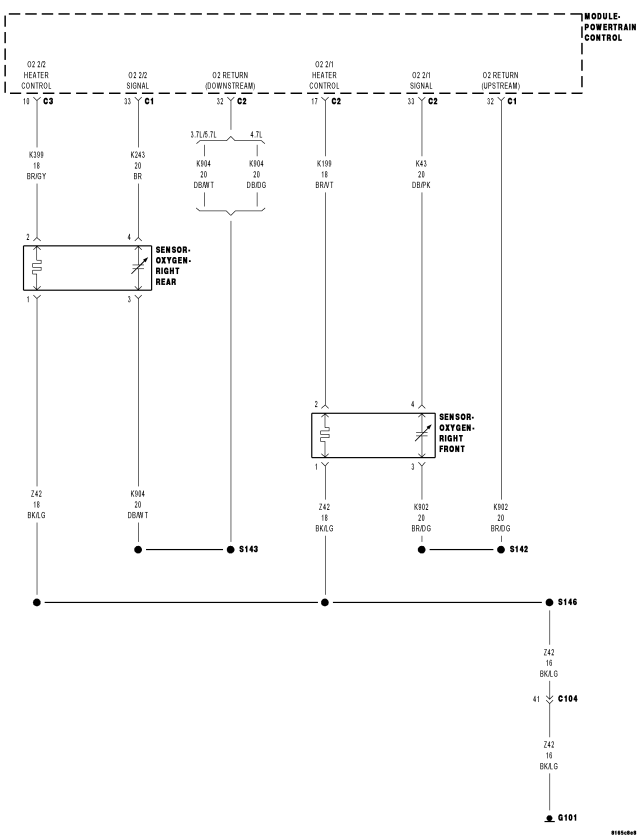
For a complete wiring diagram Refer to Section 8W.
Theory of Operation
The fuel feedback system will maintain a stoiciometric fuel/air mixture, 14.7:1, by modifying the injector pulsewidth according to the oxygen content of the exhaust gas. The PCM makes short term and long term fuel corrections to maintain stoiciometric fuel/air ratio for best catalytic converter efficiency. Short term fuel correction is based on upstream O2 sensor output and is designed for quick engine response. The long term fuel correction compensated for variations in the engine specifications, sensor tolerances and component aging and is designed to correct rich and lean conditions over a longer period of time.
- When Monitored:
With the engine running in closed loop mode, the ambient/battery temperature above -6.7°C (20°F) and altitude below 2590.8 m (8500 ft).
- Set Condition:
If the PCM multiplies short term compensation by long term adaptive and a purge fuel multiplier and the result is below a certain value for 30 seconds over two trips, a freeze frame is stored, the MIL illuminates and a trouble code is stored. Two Trip Fault. Three good trips to turn off the MIL.
| Possible Causes |
| O2 SENSOR HEATER OPERATION |
| EVAP PURGE SOLENOID OPERATION |
| O2 SIGNAL CIRCUIT |
| O2 RETURN CIRCUIT |
| O2 SENSOR |
| MAP SENSOR |
| ECT SENSOR |
| ENGINE MECHANICAL |
| FUEL FILTER/PRESSURE REGULATOR (HIGH) |
| PCM |
Always perform the Pre-Diagnostic Troubleshooting procedure before proceeding. (Refer to 9 - ENGINE - DIAGNOSIS AND TESTING).
Diagnostic Test
1.ACTIVE DTCNOTE: Check for contaminates that may have damaged an O2 Sensor: contaminated fuel, unapproved silicone, oil and coolant.
NOTE: It may be necessary to drive the vehicle to meet the conditions to set this DTC, try to repeat the conditions in which the fault originally set by reviewing the Freeze Frame data.
Is the DTC Active or Pending at this time?
Yes
- Go To 2
No
- Refer to the INTERMITTENT CONDITION Diagnostic Procedure.
- Perform the POWERTRAIN VERIFICATION TEST. (Refer to 9 - ENGINE - STANDARD PROCEDURE)
2.CHECKING FUEL PRESSURE
WARNING: The fuel system is under a constant pressure (even with the engine off). Before testing or servicing any fuel system hose, fitting or line, the fuel system pressure must be released. Failure to follow these instructions can result in personal injury or death.
NOTE: Fuel pressure specification is 407 kPa +/- 34 kPa (59 psi +/- 5 psi).
Choose a conclusion that best matches your fuel pressure reading.
Within Specification
- Go To 3
Above Specification
- Replace the fuel filter/pressure regulator.
- Perform the POWERTRAIN VERIFICATION TEST.
(Refer to 9 - ENGINE - STANDARD PROCEDURE)
CAUTION: Stop All Actuations.
3.O2 SENSOR OPERATION
NOTE: If one of the O2 Sensors Signal or Return circuit is shorted to ground or voltage, all the other O2 Sensor voltage readings will be affected.
NOTE: After the repairs have been made, verify proper O2 Sensor operation. If all the O2 Sensor voltage readings have not returned to normal, follow the diagnostic procedure for the remaining O2 Sensors.
Is the voltage switching between 2.5 and 3.4 volts?
Yes
- Go To 4
No
- Go To 9
4.2/1 O2 SENSOR HEATER OPERATION
NOTE: Wait a minimum of 10 minutes to allow the O2 Sensor to cool down before continuing the test. Allow the O2 Sensor voltage to stabilize at 5.0 volts.
Does the voltage stay above 4.5 volts for each Sensor?
Yes
- Replace the 2/1 O2 Sensor.
- Perform the POWERTRAIN VERIFICATION TEST. (Refer to 9 - ENGINE - STANDARD PROCEDURE)
No
- Go To 5
5.MAP SENSOR OPERATION
NOTE: The Barometric Pressure should be approximately equal to the actual barometric pressure. If necessary, compare the Barometric Pressure value of this vehicle to the value of a known good vehicle of a similar make and model.
NOTE: If engine will not idle, maintain a constant RPM above idle.
Is the scan tool reading for MAP Vacuum within 1" of the Vacuum Gauge reading and is the Barometric Pressure reading of the vehicle the approximately the same as actual Barometric Pressure?
Yes
- Go To 6
No
- Replace the MAP Sensor.
- Perform the POWERTRAIN VERIFICATION TEST.
(Refer to 9 - ENGINE - STANDARD PROCEDURE)
NOTE: Remove the vacuum gauge before continuing.
6.ECT SENSOR OPERATION
NOTE: For this test to be valid, the thermostat must be operating correctly.
NOTE: This test works best if performed on a cold engine (cold soak).
NOTE: If engine coolant temperature is above 82° C (180° F), allow the engine to cool until 65° C (150° F) is reached.
Did the ECT value increase smoothly and reach at least 82° C (180° F)?
Yes
- Go To 7
No
- Replace the Engine Coolant Temperature Sensor.
- Perform the POWERTRAIN VERIFICATION TEST. (Refer to 9 - ENGINE - STANDARD PROCEDURE)
7.EVAP PURGE SOLENOID OPERATION
Did the Evap Purge Solenoid hold vacuum?
Yes
- Go To 8
No
- Replace the EVAP Purge Solenoid.
- Perform the POWERTRAIN VERIFICATION TEST.
(Refer to 9 - ENGINE - STANDARD PROCEDURE)
NOTE: Connect the vacuum hoses before continuing.
8.ENGINE MECHANICAL
Are there any engine mechanical problems?
Yes
- Repair as necessary.
- Perform the POWERTRAIN VERIFICATION TEST. (Refer to 9 - ENGINE - STANDARD PROCEDURE)
No
- Go To 12
9.2/1 O2 SENSOR
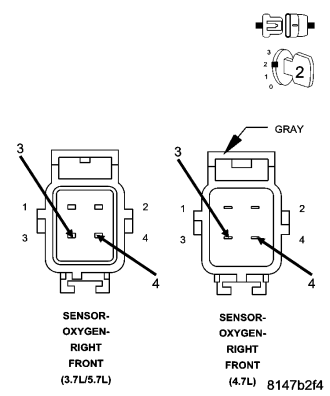
NOTE: The voltage should drop from 5.0 volts down to 2.5 volts with the jumper wire connected.
Did the O2 Sensor voltage drop from 5 volts to 2.5 volts when the jumper wire was installed?
Yes
- Replace the O2 Sensor
- Perform the POWERTRAIN VERIFICATION TEST. (Refer to 9 - ENGINE - STANDARD PROCEDURE)
No
- Go To 10
NOTE: Remove the jumper wire before continuing.
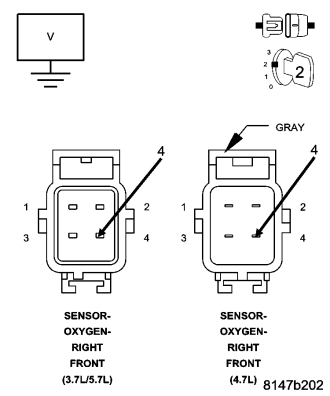
10.O2 SENSOR SIGNAL CIRCUIT
WARNING: When the engine is operating, do not stand in direct line with the fan. Do not put your hands near the pulleys, belts, or fan. Do not wear loose clothing. Failure to follow these instructions can result in personal injury or death.
Is the voltage above 4.8 volts?
Yes
- Check the (K43) O2 Sensor 2/1 Signal circuit for damage, short to ground, open, or short to voltage. Inspect the O2 Sensor connector and the PCM harness connector. If OK, replace and program the Powertrain Control Module per Service Information.
- Perform the POWERTRAIN VERIFICATION TEST. (Refer to 9 - ENGINE - STANDARD PROCEDURE)
No
- Go To 11
11.(K902) O2 SENSOR RETURN UPSTREAM CIRCUIT
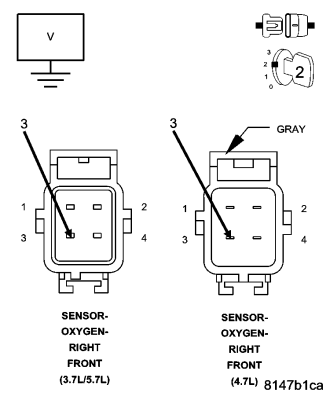
Is the voltage at 2.5 volts?
Yes
- Go To 12
No
- Check the (K902) O2 Return Upstream circuit for damage, short to ground, open, or short to voltage. Inspect the O2 Sensor connector and the PCM harness connector. If OK, replace and program the Powertrain Control Module per Service Information.
- Perform the POWERTRAIN VERIFICATION TEST.
(Refer to 9 - ENGINE - STANDARD PROCEDURE)
NOTE: Turn the ignition off before continuing.
12.PCM
NOTE: Before continuing, check the PCM harness connector terminals for corrosion, damage, or terminal push out. Repair as necessary.
Were there any problems found?
Yes
- Repair as necessary.
- Perform the POWERTRAIN VERIFICATION TEST. (Refer to 9 - ENGINE - STANDARD PROCEDURE)
No
- Replace and program the Powertrain Control Module per Service Information.
- Perform the POWERTRAIN VERIFICATION TEST. (Refer to 9 - ENGINE - STANDARD PROCEDURE)