P0153-O2 SENSOR 2/1 SLOW RESPONSE
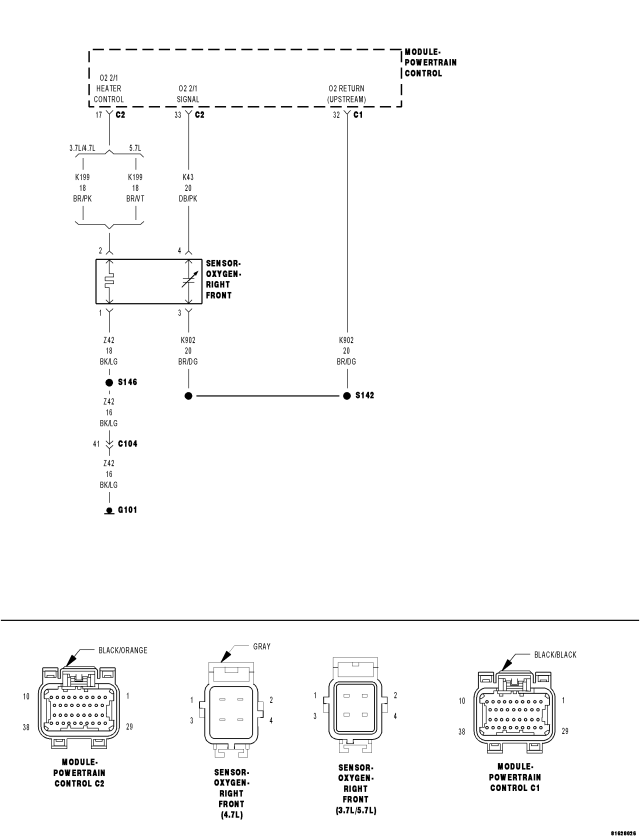
For a complete wiring diagram Refer to Section 8W.
Theory of Operation
For an aged O2 sensor , the response rate to the air/fuel change is slower than when it was new. The O2 sensor tends to move less with the same air/fuel changes in a given time frame. Therefore by observing the activity of voltage readings from the upstream O2 sensor, the quality of the O2 sensor can be detected.
- When Monitored:
Vehicle is started and driven between 32 and 88.5 km/h (20 and 55 mph) with the Throttle open for a minimum of 120 seconds. Coolant greater than 70° (158° F). Catalytic Converter Temp greater than 600° C (1112° F) and EVAP Purge is active.
- Set Condition:
O2 Sensor response is too slow for a calibrated amount of time. Two Trip Fault. Three good trips to turn off the MIL.
| Possible Causes |
| EXHAUST LEAK |
| (K43) O2 2/1 SIGNAL CIRCUIT |
| (K902) O2 RETURN UPSTREAM CIRCUIT |
| O2 SENSOR |
Always perform the Pre-Diagnostic Troubleshooting procedure before proceeding. (Refer to 9 - ENGINE - DIAGNOSIS AND TESTING).
Diagnostic Test
1.ACTIVE DTCNOTE: Check for contaminants that may have damaged the O2 Sensor: contaminated fuel, unapproved silicone, oil and coolant.
NOTE: After the repairs have been made, verify proper O2 Sensor operation. If all the O2 Sensor voltage readings have not returned to normal, follow the diagnostic procedure for the remaining O2 Sensors.
NOTE: It may be necessary to drive the vehicle to meet the conditions to set this DTC, try to repeat the conditions in which the fault originally set by reviewing the Freeze Frame data.
Is the DTC Active or Pending at this time?
Yes
- Go To 2
No
- Refer to the INTERMITTENT CONDITION Diagnostic Procedure.
- Perform the POWERTRAIN VERIFICATION TEST. (Refer to 9 - ENGINE - STANDARD PROCEDURE)
2.CHECKING THE EXHAUST SYSTEM FOR LEAKS
WARNING: The normal operating temperature of the exhaust system is very high. Never work around or attempt to service any part of the exhaust system until it has cooled. Special care should be taken when working near the catalytic converter. The temperature of the converter rises to a high level after a short period of engine operating time
CAUTION: The air pressure must not exceed 27.6 kPa (4 psi), otherwise engine damage can occur.
Type 1 Leak
Type 2 Leak
| Leak Location | Repair required if results at 27.6 kPa (4 psi) reveal bubble size: |
| Welded joints | Type 1, 1 mm (0.04 of an inch) or greater |
| O2 Sensor seal points | Type 1, 1 mm (0.04 of an inch) or greater |
| O2 Sensor boss welds | Type 1, 1 mm (0.04 of an inch) or greater |
| Flange / joint connections | Type 2, 8 mm (0.3 of an inch) or greater |
| Exhaust Manifold to cylinder head connections | Type 2, 8 mm (0.3 of an inch) or greater |
| EGR gasket and tube seal points | Type 2, 8 mm (0.3 of an inch) or greater |
Were any exhaust leaks found?
Yes
- Repair or replace the leaking exhaust parts as necessary.
- Perform the POWERTRAIN VERIFICATION TEST. (Refer to 9 - ENGINE - STANDARD PROCEDURE)
No
- Go To 3
3.(K43) O2 2/1 SIGNAL CIRCUIT
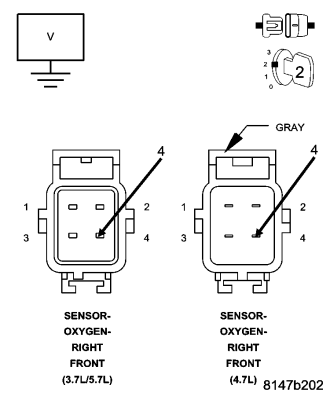
Is the voltage between 4.5 and 5.0 volts?
Yes
- Go To 4
No
- Check the (K43) O2 2/1 Signal circuit for a short to ground, open, or short to voltage. If OK, replace and program the Powertrain Control Module per Service Information.
- Perform the POWERTRAIN VERIFICATION TEST. (Refer to 9 - ENGINE - STANDARD PROCEDURE)
4.(K902) O2 RETURN UPSTREAM CIRCUIT
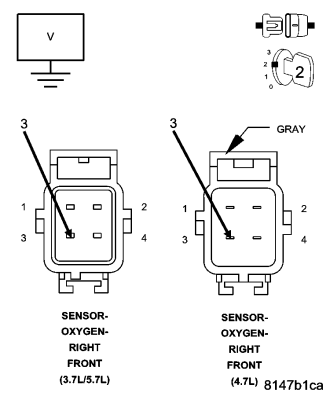
Is the voltage at 2.5 volts?
Yes
- Go To 5
No
- Check the (K902) O2 Return Upstream circuit for a short to ground, open, or short to voltage. If OK, replace and program the Powertrain Control Module per Service Information.
- Perform the POWERTRAIN VERIFICATION TEST. (Refer to 9 - ENGINE - STANDARD PROCEDURE)
5.O2 SENSOR
If there are no possible causes remaining, view repair.
Repair
- Replace the O2 Sensor
- Perform the POWERTRAIN VERIFICATION TEST. (Refer to 9 - ENGINE - STANDARD PROCEDURE)