STANDARD PROCEDURE - CONVENTIONAL BATTERY CHARGING
CAUTION: Vehicles equipped with a diesel engine utilize a unique spiral cell battery. This battery has a maximum charging voltage that must be used in order to restore the battery to its full potential, failure to use the spiral cell battery charging procedure could result in damage to the battery or personal injury. (Refer to 8 - ELECTRICAL/BATTERY SYSTEM/BATTERY - STANDARD PROCEDURE - SPIRAL CELL BATTERY CHARGING) for the appropriate procedure.
Battery charging is the means by which the battery can be restored to its full voltage potential. A battery is fully-charged when:
- Micro 420 battery tester indicates battery is OK.
- Open-circuit voltage of the battery is 12.65 volts or above.
- Battery passes Load Test multiple times.
WARNING: If the battery shows signs of freezing, leaking, loose posts, do not test, assist-boost, or charge. The battery may arc internally and explode. Personal injury and/or vehicle damage may result.
WARNING: Explosive hydrogen gas forms in and around the battery. Do not smoke, use flame, or create sparks near the battery. Personal injury and/or vehicle damage may result.
WARNING: The battery contains sulfuric acid, which is poisonous and caustic. Avoid contact with the skin, eyes, or clothing. In the event of contact, flush with water and call a physician immediately. Keep out of the reach of children.
WARNING: If the battery is equipped with removable cell caps, be certain that each of the cell caps is in place and tight before the battery is returned to service. Personal injury and/or vehicle damage may result from loose or missing cell caps.
CAUTION: Always disconnect and isolate the battery negative cable before charging a battery. Do not exceed sixteen volts while charging a battery. Damage to the vehicle electrical system components may result.
CAUTION: Battery electrolyte will bubble inside the battery case during normal battery charging. Electrolyte boiling or being discharged from the battery vents indicates a battery overcharging condition. Immediately reduce the charging rate or turn off the charger to evaluate the battery condition. Damage to the battery may result from overcharging.
CAUTION: The battery should not be hot to the touch. If the battery feels hot to the touch, turn off the charger and let the battery cool before continuing the charging operation. Damage to the battery may result.
After the battery has been charged to an open-circuit voltage reading of 12.4 volts or greater, retest the battery with the Micro 420 tester or perform a load test to determine the battery cranking capacity. (Refer to 8 - ELECTRICAL/BATTERY SYSTEM/BATTERY - STANDARD PROCEDURE - USING MICRO 420 BATTERY TESTER) for the proper battery test procedures. If the battery passes a load test, return the battery to service. If the battery fails a load test, it is faulty and must be replaced.
Clean and inspect the battery hold downs, tray, terminals, posts, and top before completing battery service. (Refer to 8 - ELECTRICAL/BATTERY SYSTEM - CLEANING) for the proper battery system cleaning procedures. (Refer to 8 - ELECTRICAL/BATTERY SYSTEM - INSPECTION) for the proper battery system inspection procedures.
CHARGING A COMPLETELY DISCHARGED CONVENTIONAL BATTERY
The following procedure should be used to recharge a completely discharged battery. Unless this procedure is properly followed, a good battery may be needlessly replaced.
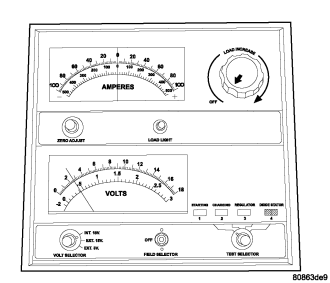
| Voltage | Minutes |
| 16.0 volts maximum | up to 10 min. |
| 14.0 to 15.9 volts | up to 20 min. |
| 13.9 volts or less | up to 30 min. |
CHARGING TIME REQUIRED
The time required to charge a battery will vary, depending upon the following factors:
- Battery Capacity - A completely discharged heavy-duty battery requires twice the charging time of a small capacity battery.
- Temperature - A longer time will be needed to charge a battery at -18° C (0° F) than at 27° C (80° F). When a fast battery charger is connected to a cold battery, the current accepted by the battery will be very low at first. As the battery warms, it will accept a higher charging current rate (amperage).
- Charger Capacity - A battery charger that supplies only five amperes will require a longer charging time. A battery charger that supplies twenty amperes or more will require a shorter charging time.
- State-Of-Charge - A completely discharged battery requires more charging time than a partially discharged battery. Electrolyte is nearly pure water in a completely discharged battery. At first, the charging current (amperage) will be low. As the battery charges, the specific gravity of the electrolyte will gradually rise.
The Conventional Battery Charging Time Table gives an indication of the time required to charge a typical battery at room temperature based upon the battery state-of-charge and the charger capacity.
| Charging Amperage | 5 Amps | 10 Amps | 20 Amps |
| Open Circuit Voltage | Hours Charging @ 21° C (70° F) | ||
| 12.25 to 12.49 | 6 hours | 3 hours | 1.5 hours |
| 12.00 to 12.24 | 10 hours | 5 hours | 2.5 hours |
| 10.00 to 11.99 | 14 hours | 7 hours | 3.5 hours |
| Below 10.00 | 18 hours | 9 hours | 4.5 hours |